Beyond the Ladder: Why Ground-Based Drone Operations are the Future of OSHA Compliance in Facility Maintenance

The commercial facility maintenance industry is currently navigating a period of profound structural and technological transformation. Historically, the upkeep of mid-rise real estate, sprawling industrial campuses, and municipal infrastructure has been constrained by the physical limitations and inherent dangers of scaffolding, boom lifts, and rope descent systems. Today, a paradigm shift is occurring as facility managers transition from manual, elevated labor to ground-controlled, precision-guided aerial robotics.
The Actuarial Reality of Traditional Maintenance
For decades, the standard for exterior maintenance involved placing human workers at extreme, often precarious elevations. This operational model carries a staggering actuarial risk profile. Data published by the Occupational Safety and Health Administration (OSHA) paints a stark picture: an analysis of window cleaning accidents over 15 years identified 88 severe incidents, 70% of which resulted in fatal outcomes. (1)
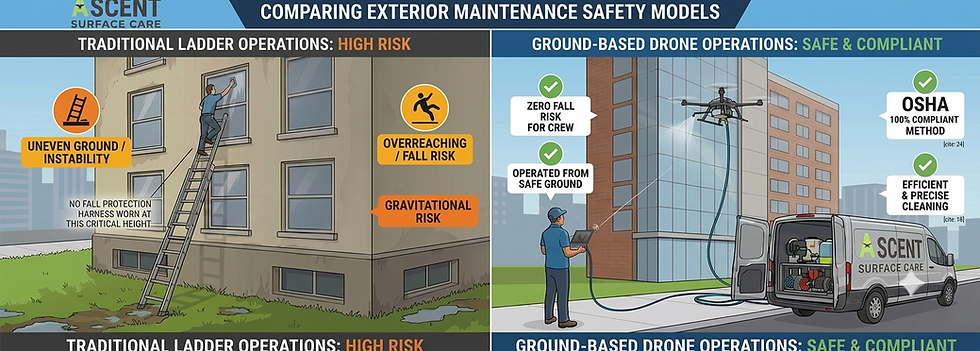
While high-rise accidents often capture headlines, the most pervasive danger lies in relatively low-elevation work. Ladder-related incidents account for an astonishing 81% of all window cleaning falls. Statistically, the highest frequency of severe injuries occurs at elevations of just 8 to 12 feet, where workers frequently bypass essential fall protection protocols, perceiving the height as low-risk. (2) Environmental factors common in the Texas market, such as soft soil and wet landscaping pavers, further exacerbate ladder instability and the risk of catastrophic tip-overs.
Decoupling Human Capital from Gravitational Risk
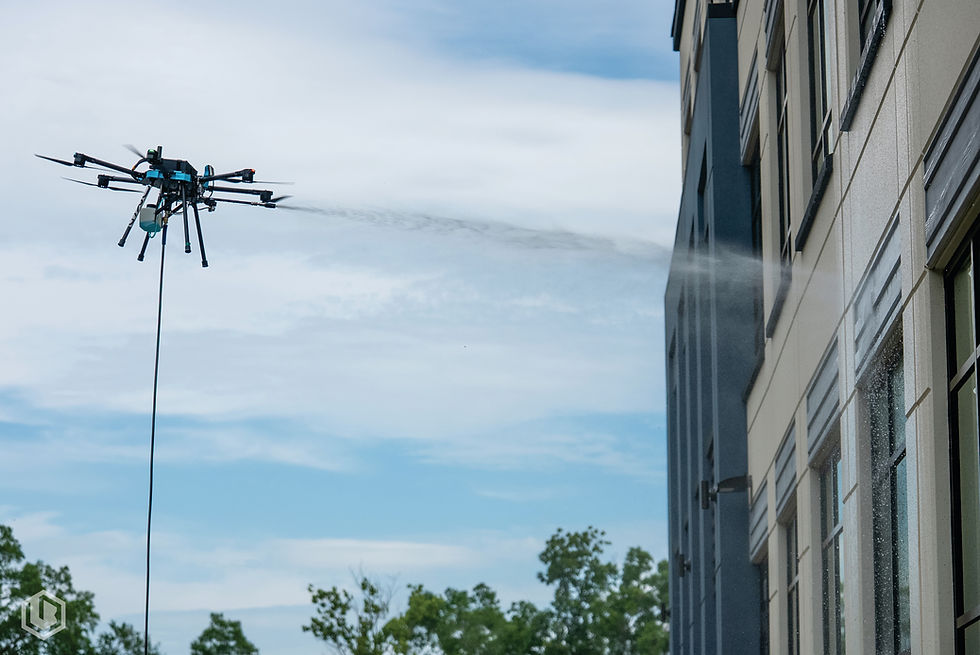
Drone technology fundamentally moves exterior maintenance from a high-risk operational expenditure to a safe, automated facility management utility. By deploying industrial-grade UAVs like the Lucid Bots Sherpa, the entire maintenance project is operated from a safe ground location. This methodology delivers the chemical payload to elevations up to approximately 200 feet without exposing a single crew member to the risk of a fall.
These systems are not merely "flying pressure washers." They function as highly stabilized aerial positioning systems for specialized fluid delivery. Because the drone bears the entire vertical payload, the risks associated with equipment degradation in rope descent systems or mechanical failure in swing stages are entirely eliminated.
Mitigating Property Manager Liability
When a facility director hires a traditional cleaning contractor, the property owner inherently assumes a degree of significant liability exposure. Beyond the human risk, legacy methods like diesel boom lifts weigh tens of thousands of pounds and frequently cause structural damage by crushing manicured landscaping or cracking pedestrian sidewalks.
The shift to ground-based drone operations provides several compliance and risk-mitigation advantages:
100% OSHA Compliance: By keeping crews on the ground, the primary mechanism for workplace fatalities—the fall—is removed from the equation.
Aviation-Grade Professionalism: Modern drone service providers operate as commercial aviation professionals. Operations are conducted by FAA Part 107 certified pilots who utilize legal airspace authorizations for complex urban environments.
Enhanced Insurance Moats: Leading providers now carry specialized aviation liability insurance, often up to $5 million, specifically to meet the strict vendor compliance requirements of Class A property managers.
Provided by Lucid Bots (lucidbots.com)
Operational Velocity Meets Safety
Transitioning to robotic systems does more than just enhance safety; it drastically increases operational velocity. A commercial drone can clean at a rate exceeding 300 square feet per minute, achieving a turnaround time twice as fast as traditional window and soft wash methodologies. This means a mid-rise project that would traditionally take a human rope-access crew weeks to complete can now be revitalized in just days, ensuring minimal disruption to tenant operations and emergency access routes.
As the commercial exterior cleaning market is projected to grow to over $45 billion by 2035, the adoption of drone-facilitated maintenance is no longer a technological novelty. It is a data-driven imperative for any facility manager looking to ensure strict safety compliance while maximizing the lifecycle and valuation of their architectural assets.
Citations:
Window Washers by HealthDay News (Dec 31, 2020). HealthDay.
Ladder Falls at Work and How to Avoid Them by Society Insurance Team (n.d.). Society Insurance.


Comments