Mid-Rise Window Cleaning: Methods and Safety

For facility directors and property managers, mid-rise commercial buildings—typically spanning three to fifteen stories—present a unique exterior maintenance challenge. They are far too tall for standard ground-level cleaning methods, yet they often lack the permanent rooftop Building Maintenance Units (BMUs) and extensive rigged infrastructure found on towering skyscrapers.
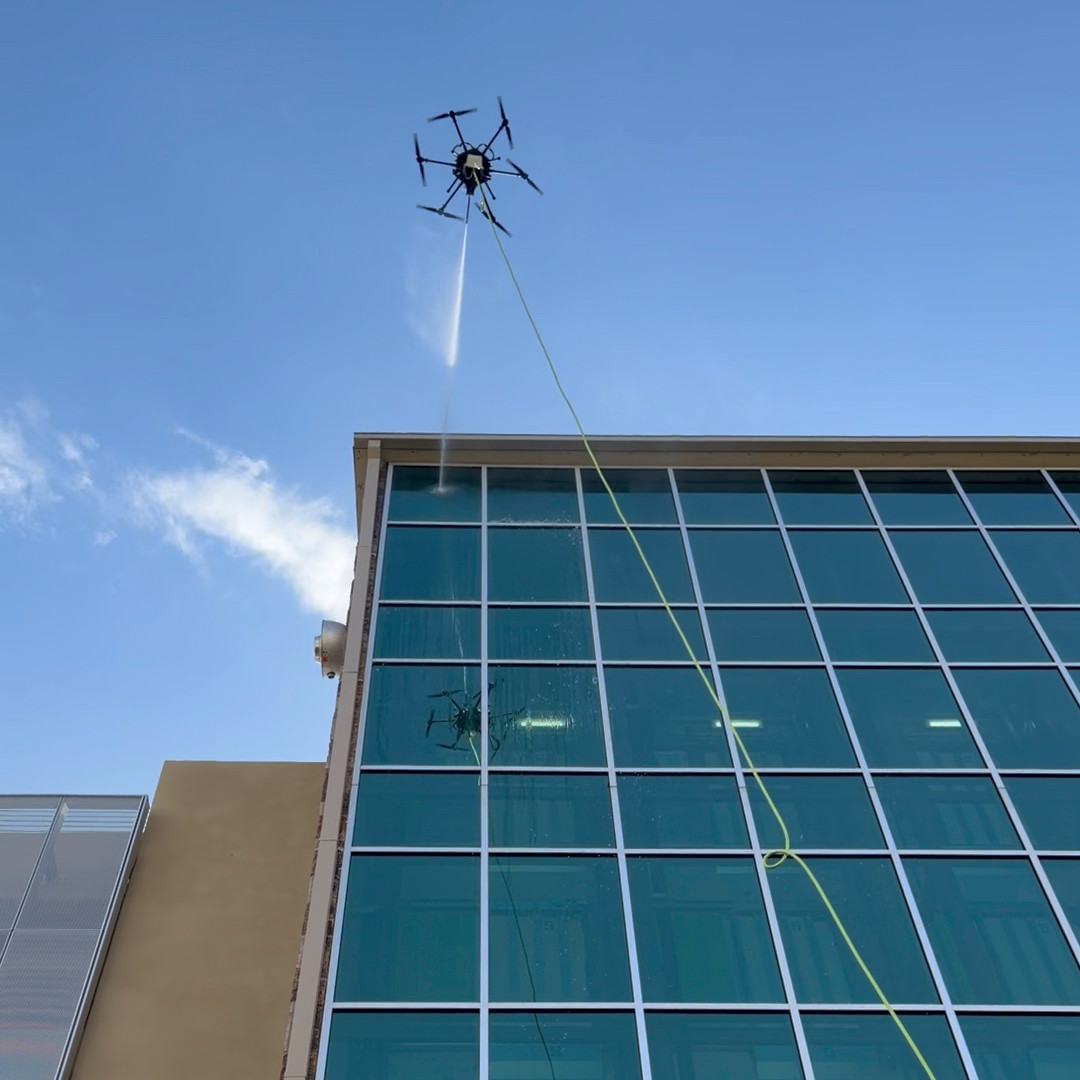
Maintaining pristine, streak-free glass on a mid-rise requires a careful balance of methodology, budget, and above all, rigorous safety standards. With the introduction of advanced aerospace technology into the commercial surface care industry, the way we approach these structures is fundamentally shifting. Here is a comprehensive look at the methods, safety protocols, and modern evolutions in mid-rise window cleaning.
Traditional Mid-Rise Cleaning Methods
Historically, accessing the exterior envelope of a multi-story building required putting human workers in the air. Depending on the exact height and architectural geometry of the property, vendors traditionally rely on a few standard methods:
Mobile Elevating Work Platforms (Boom Lifts): Lifts provide a stable platform for workers to clean mid-level windows. However, they require heavy machinery that can block pedestrian walkways, damage landscaping, and disrupt daily tenant operations. Furthermore, many mid-rise properties simply lack the ground-level clearance to safely maneuver a large boom lift.
Suspended Scaffolding (Swing Stages): For buildings approaching 10 to 15 stories, temporary swing stages are often deployed. This involves extensive rigging, anchor point testing, and days of setup before a single window is washed.
Rope Access (Bosun’s Chairs): Highly trained technicians rappel down the side of the building. While this solves the ground-footprint issue, it introduces maximum liability and places workers at extreme physical risk.
The Weight of OSHA Compliance and Liability
Safety is the absolute cornerstone of commercial window cleaning. According to industry data, falls remain the leading hazard in exterior facility maintenance. When property managers hire a traditional window cleaning crew to work at height, they must ensure the vendor strictly adheres to OSHA and ANSI standards.
Compliance for at-height work is exhaustive. It includes mandatory daily inspections of carabiners, harnesses, and descent control devices, alongside rigorous anchor point certifications. Environmental factors play a major role as well; traditional crews must halt operations when sustained wind speeds exceed safe limits.
For property managers, the hidden cost of traditional methods is the liability. No matter how robust the safety protocols, deploying human beings 100 feet in the air suspended by ropes or hydraulic arms inherently carries massive operational risk.
The Modern Evolution: Ground-Based Operations
The ultimate way to comply with OSHA's fall protection standards is to engineer the fall risk entirely out of the equation. This is where the facility maintenance industry is experiencing a rapid technological pivot.
Water-fed Poles and heavy-lift drones are actively replacing the need for scaffolding, boom lifts, and rope access on mid-rise properties. Operating entirely from a secured ground perimeter, specialized drone fleets can access complex building geometries up to 200 feet high.
Why Property Managers are Making the Switch
Zero Fall Liability: By delivering the cleaning payload aerially, operators remain safely on the ground, completely insulating the property management group from the liability of at-height accidents.
Spotless Chemistry: Modern aerial systems utilize purified Deionized (DI) water. Stripped of all minerals, DI water acts as a "hungry" solvent that naturally binds to environmental pollutants, drying perfectly clear without the need for manual squeegeeing.
Operational Velocity: Drone fleets can clean up to 300 square feet per minute, yielding turnaround times up to twice as fast as traditional rope-access crews. A multi-week project can often be condensed into just a few days.
Minimal Disruption: Without heavy machinery blocking entrances or swing stages hanging outside executive offices, daily corporate or tenant operations continue completely uninterrupted.
Mid-rise window cleaning no longer requires choosing between massive liability, heavy machinery, or exorbitant costs. As drone-powered surface care becomes the new industry standard, facility managers are discovering that the safest way to maintain a building is to keep their maintenance operations firmly planted on the ground. Check out our Window Cleaning page for more information.


Comments